

Mechanical Automation Engineer
Carrying out the business of waste oil recycling is not just about choosing the recycling plants and estimating the product prices. First and foremost, you need to clearly determine: How much waste oil can be steadily collected each month?
This data will directly affect the scale of the recycling plant, the utilization rate of equipment, the operating costs, and the final profitability.
If the recycling plant is too large but the existing raw material supply is insufficient, the utilization rate of equipment will decrease, and the processing cost per ton of waste oil will increase. Conversely, if the waste oil recycling plant is too small, it may also result in some raw materials not being processed in time.
This guide will introduce how to estimate the supply of waste oil, match the appropriate production capacity of the recycling plant, evaluate the quality of raw materials, and determine whether the existing supply is sufficient to support a profitable waste oil recycling business.
Start With Your Available Waste Oil Supply
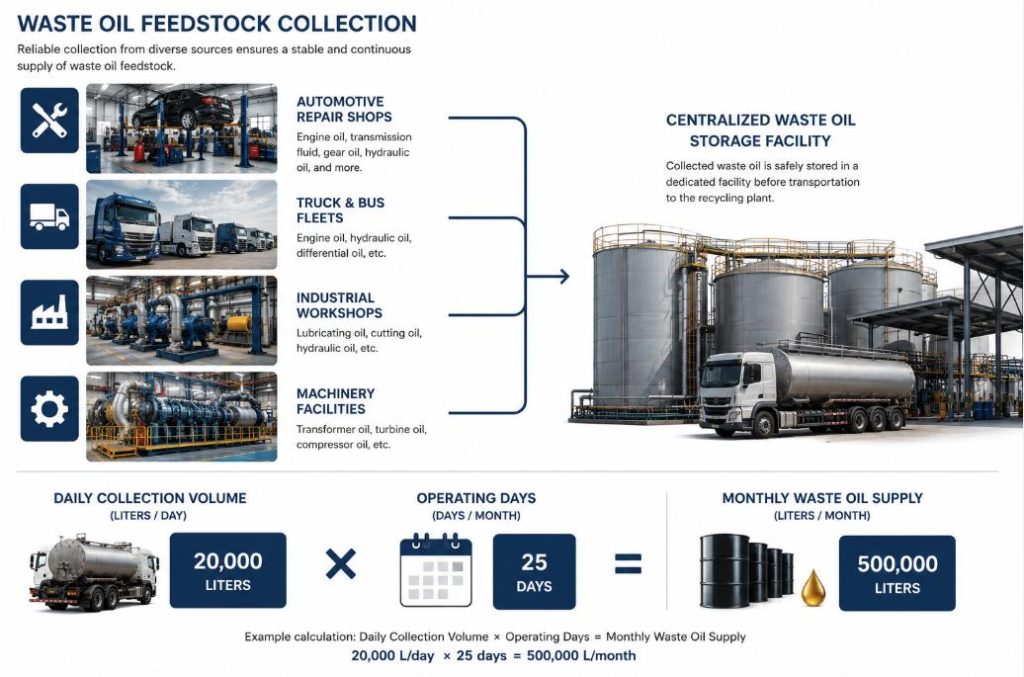
Before choosing an oil recycling plant, it is necessary to determine how much waste oil can be continuously collected, rather than estimating the total amount of waste oil in the market.
The sources of waste oil include auto repair shops, truck and bus fleets, transportation companies, factories, mechanical workshops, mines, and other industrial facilities. However, the waste oil generated in these areas may not all be suitable as your raw materials.
The actual supply volume depends on the collection network, transportation distance, supplier agreements, local regulations, and competition from other waste oil collectors.
The monthly supply volume can be estimated using the following formula:
Monthly waste oil supply = Average daily collection volume × Monthly collection days
For example, the average collection network can provide 8 tons of waste oil per day, and collects for 25 days per month:
8 × 25 = 200 tons/month
Therefore, the actual raw material supply is approximately 200 tons per month.
When planning the recycling plant, it is recommended to use a conservative estimate. If the supply volume fluctuates greatly, designing the plant based on the highest collection volume may result in insufficient equipment utilization during low supply periods.
Therefore, the key is not how much waste oil can be collected at its maximum, but how much waste oil can be stably supplied to the recycling plant throughout the year.
Match Your Waste Oil Supply With Plant Capacity
After identifying the available raw materials, the next step is to determine the appropriate factory production capacity.
The production capacity of an oil recycling plant is usually expressed in tons per day (TPD). For example, a 10 TPD plant can process approximately 10 tons of waste oil under specific process conditions each day.
The monthly processing capacity can be calculated using the following formula:
Monthly processing capacity = Daily processing capacity × Number of operating days For example:
- 10 TPD × 25 days = 250 tons/month
- 20 TPD × 25 days = 500 tons/month
- 50 TPD × 25 days = 1,250 tons/month
If the enterprise can supply approximately 250 tons of waste oil per month stably, a 10 TPD factory might be a reasonable starting point. If the monthly supply volume reaches 500 tons or more, a larger production capacity can be considered.
As a preliminary reference:
| Available Waste Oil | Possible Plant Capacity |
| 100–200 tons/month | 5–10 TPD |
| 200–500 tons/month | 10–20 TPD |
| 500–1,000 tons/month | 20–40 TPD |
| 1,000+ tons/month | 40–50+ TPD |
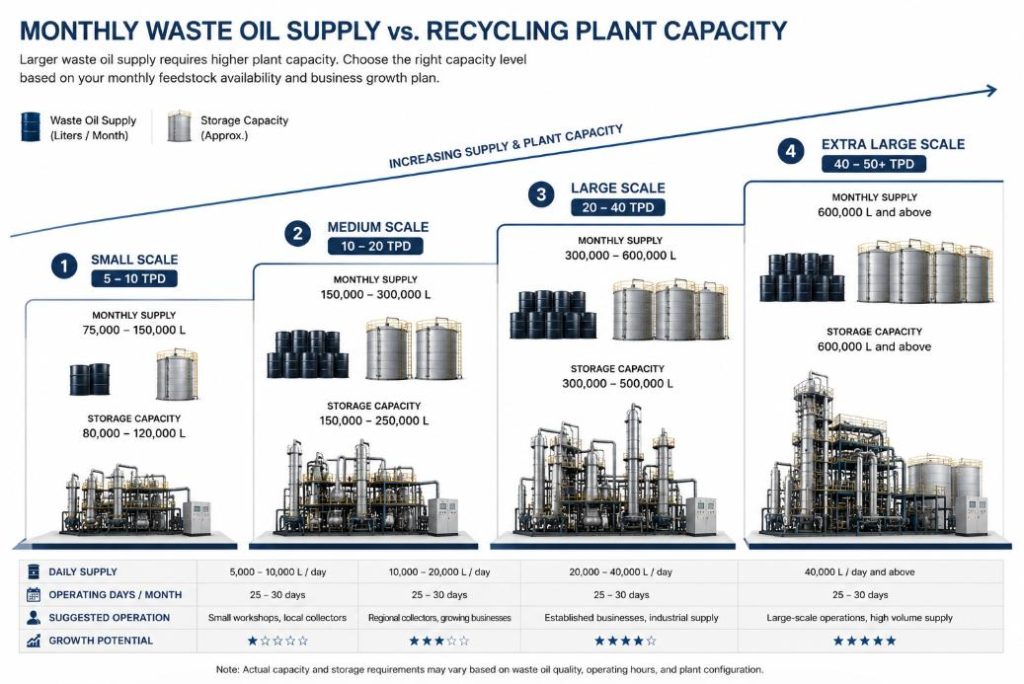
These data are only for preliminary planning. The final factory capacity should also take into account the quality of raw materials, operation plans, target products, storage capacity, investment budget, and local market conditions.
A common mistake is to choose the largest-scale factory based on the investment budget. A larger factory does not necessarily mean higher profitability. If the supply of waste oil is insufficient to maintain a reasonable equipment utilization rate, some of the production capacity may remain idle for a long time.
A more reasonable approach is to start from a stable and reliable raw material supply and determine the appropriate processing capacity in reverse.
Waste Oil Quality Matters as Much as Quantity
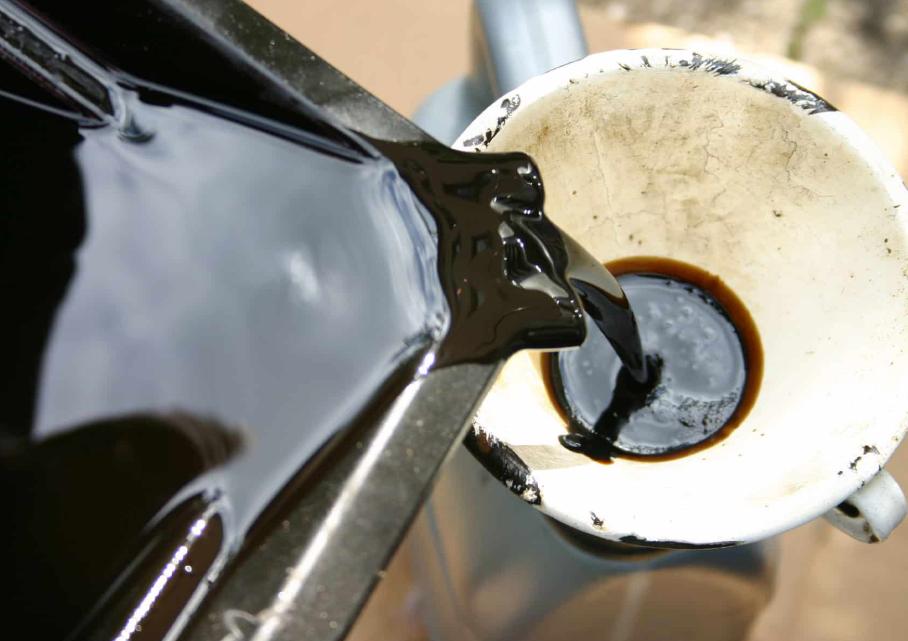
For instance, two suppliers can each provide 500 tons of waste oil per month, but the composition of the raw materials may be completely different.
One supplier might offer waste engine oil with lower moisture and sludge content, while the other might provide contaminated waste oil containing a large amount of water, sediment, sludge, and other impurities.
These differences will directly affect the recycling process. The key characteristics of the raw materials to be noted include:
- Moisture content
- Sludge and sediment
- Light fractions
- Metal contaminants
- Additives and degradation products
- Other industrial pollutants
Low-quality raw materials will increase the need for pre-treatment, energy consumption, residue production, and operating costs, and may also reduce the output and quality of the final product.
Therefore, when estimating profitability, one cannot only consider the total tonnage of waste oil. For example, 500 tons of relatively clean raw materials may be more valuable than 700 tons of severely contaminated raw materials.
Before determining the equipment configuration, it is recommended to conduct representative sample tests on the waste oil to determine the appropriate pre-treatment and refining processes, and to more accurately estimate the product yield.
If the raw materials come from multiple sources, this is especially important. Instead of assuming that all waste oil components are the same, it is better to plan the factory and process based on the actual raw material characteristics.
How Much Waste Oil Do You Need to Make the Plant Profitable?
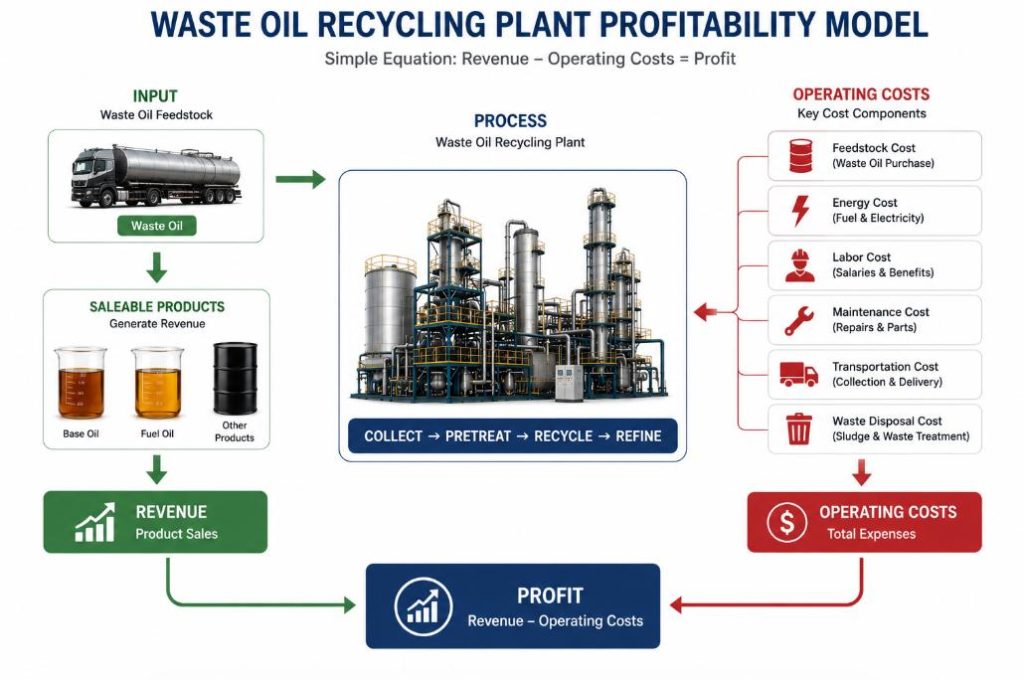
There is no universal amount of waste oil that can guarantee the profitability of the recycling plant.
Profitability depends on various factors, including raw material supply, product output, product price, energy consumption, labor costs, maintenance costs, transportation costs, and waste treatment costs.
The simplified calculation formula is:
Revenue = Saleable Products × Price
Meanwhile:
Operating Costs = Raw Material Costs + Energy Costs + Labor Costs + Maintenance Costs + Chemical Costs + Transportation Costs + Other Costs
Therefore:
Expected profit = Revenue – Operating costs
This also explains why more waste oil does not necessarily mean higher profits.
For example, suppose an investor can consistently collect 300 tons of waste oil per month. A factory with a daily processing capacity of 10 tons, if operating 25 days a week, can process approximately 250 tons of waste oil per month, and the remaining raw materials can serve as a certain supply buffer.
If the same investor purchases a larger factory without ensuring an additional raw material supply, then the equipment may not be able to operate at the designed capacity. Due to the fixed costs being allocated to a smaller output, the cost per ton of waste oil for the enterprise may be higher.
On the other hand, if the investor can obtain 800 to 1000 tons of suitable waste oil per month but only builds a very small factory, then the enterprise may not be able to fully utilize its raw material supply and market opportunities.
Therefore, it is important to achieve a good balance among raw material supply, factory utilization rate, product output, and market demand.
The target product is also crucial. A factory aimed at producing fuel or diesel may have different process requirements from a factory aimed at producing high-quality base oil. Therefore, the expected product output and selling price should be included in the project cost accounting.
Before making an investment decision, it is best to conduct an economic analysis using local actual data rather than relying on industry general estimates.
How to Determine the Right Plant Size for Your Project
Selecting the appropriate capacity of an oil waste recycling plant can be accomplished through five basic steps.
Step 1: Estimate the monthly supply of waste oil
Calculate the actual amount of waste oil that can be collected from existing and potential suppliers.
Step 2: Test the quality of raw materials
Analyze representative samples to understand moisture, sludge, sediment, and other contaminants that may affect the refining process and product yield.
Step 3: Determine the target product
Clarify whether the business aims to produce recycled fuel, diesel, base oil, or other products. The target product will determine the required refining techniques and equipment configuration.
Step 4: Determine the processing capacity
Match the monthly raw material supply with the daily processing capacity and planned operating days of the plant, taking into account seasonal variations, equipment maintenance, and supply fluctuations.
Step 5: Evaluate economic benefits
Estimate the product output and selling price, and calculate the costs of raw materials, energy, labor, maintenance, transportation, and other operational expenses.
A suitable oil waste recycling plant is not necessarily the largest scale within the budget. What is more important is that the capacity matches the stable raw material supply, maintains a reasonable equipment utilization rate, and produces products that meet the market demand.
Read more: What Capacity Used Oil Recycling Plant Do You Need?
To Conclude
If you are planning an oil waste recycling project, you can prepare the following three pieces of information first: estimated monthly supply, type and quality of raw materials, and target recycled products. These data are more valuable than simply choosing a plant based on the maximum processing capacity of the equipment, and can help determine the appropriate capacity and refining process.
If you are evaluating an oil waste recycling project, you can provide our engineering team with the estimated monthly supply, type and target product of waste oil to assess the processing capacity and refining process suitable for your project.