
Mechanical Automation Engineer
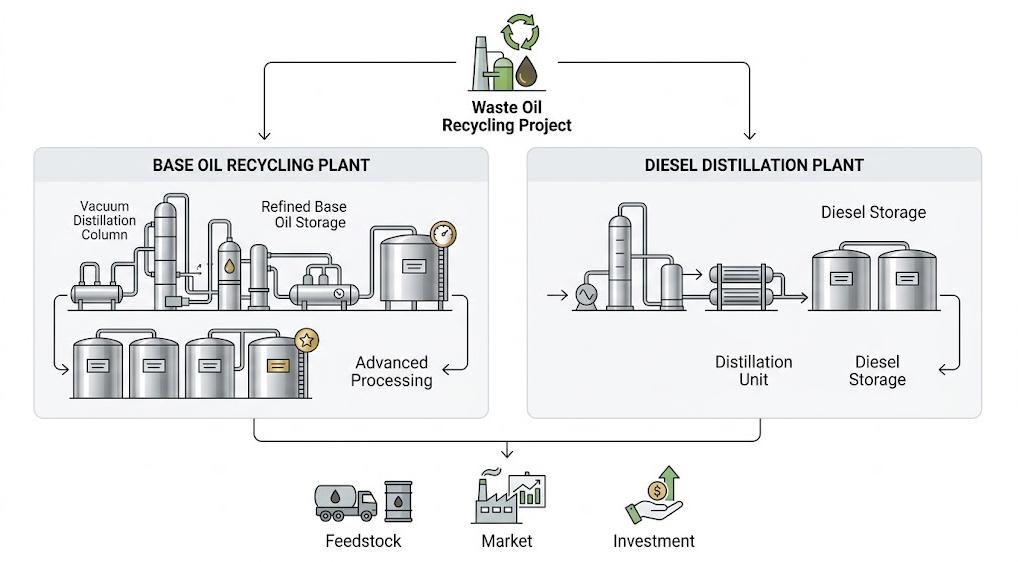
If you plan to engage in the business of waste oil recycling, an important decision to make is: should the waste oil be processed into base oil or diesel?
Generally speaking, recycled base oil from waste oil has a higher profit potential because the product value of recycled base oil is usually higher than that of fuel oil. However, producing base oil requires more refining steps and higher-quality raw materials, and the initial investment is also larger.
In contrast, factories that convert waste oil into diesel have relatively lower investment costs and simpler production processes. The specific choice depends on factors such as the local price of waste oil, product selling price, recovery rate, energy consumption, and market demand.
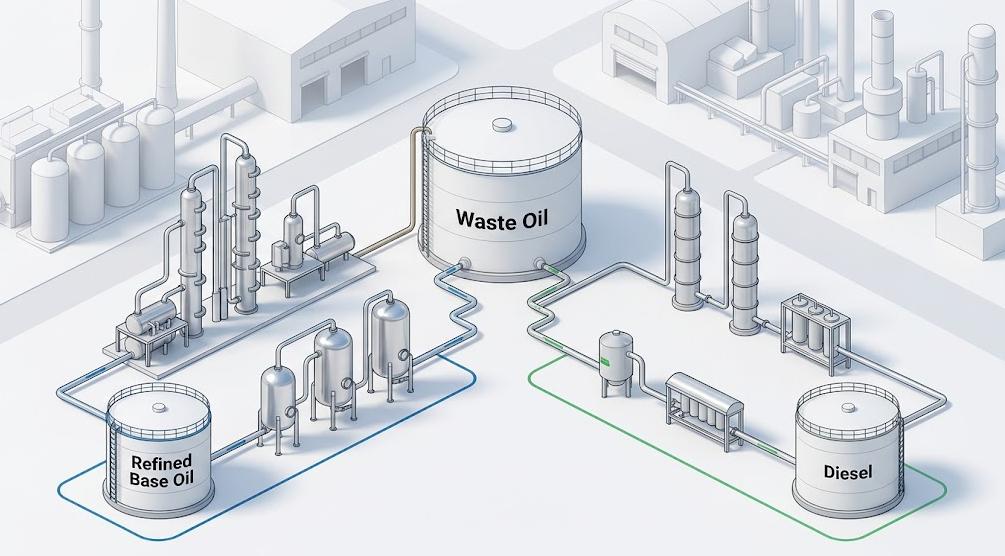
Waste Oil to Base Oil vs Waste Oil to Diesel: Key Differences
The two recycling routes have different economics.
| Factor | Waste Oil to Base Oil | Waste Oil to Diesel |
| Product value | Generally higher | Generally lower |
| Processing complexity | Higher | Lower |
| Plant investment | Higher | Lower |
| Refining requirements | More advanced | Relatively simple |
| Operating requirements | Higher | Lower |
| Profit potential per ton | Higher potential | Moderate potential |
| Best suited for | Long-term refining business | Lower-cost fuel production |
The key point is that a high product yield does not necessarily lead to higher profits.
The diesel unit may produce more liquid products, but the selling price and quality requirements are equally important. In contrast, the total amount of saleable liquids produced by the base oil unit may be less, but with higher product value, it often achieves higher unit raw material income.
How to Calculate Waste Oil Recycling Profit
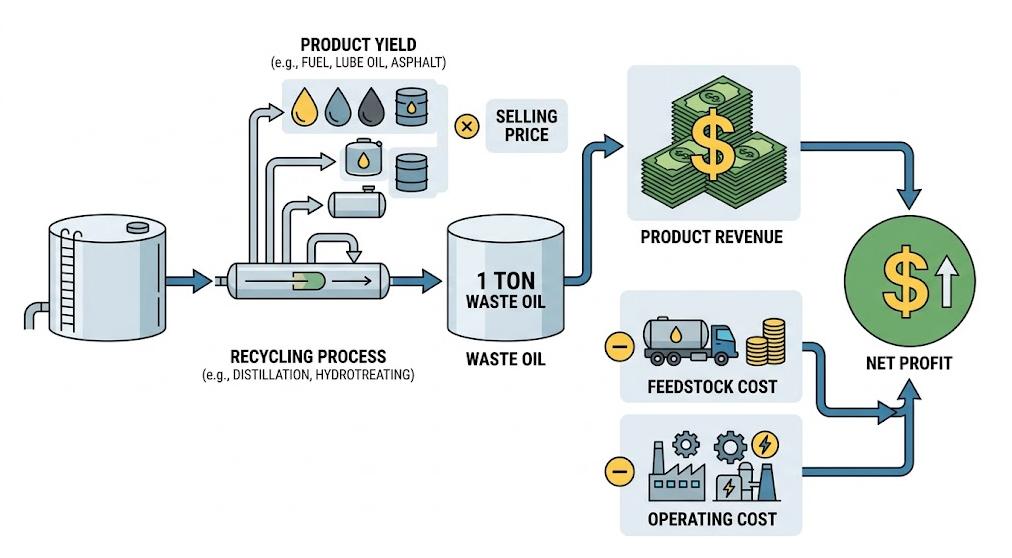
Investors should not merely compare the equipment prices, but should calculate the potential profit based on the actual costs of raw materials and products.
The basic formula is:
Profit = Product Revenue – Raw Material Cost – Operating Cost – Depreciation and Financing Cost
Among them:
Product revenue = Product yield × Product selling price
For example, a factory processes 1,000 kilograms of waste oil:
The base oil recycling plant can obtain a certain amount of recycled base oil and increase revenue through light distillates and other by-products.
The diesel production plant may obtain more fuel products, but the unit price of the finished products may be lower.
Therefore, what really needs to be compared is not:
“Which process produces more products?”
But:
“Which process can generate higher net profit from each ton of waste oil?”
Actual profits will also be affected by factors such as raw material composition, factory design, product specifications, energy prices, and local market conditions.
Why Waste Oil to Base Oil Can Be More Profitable
The core advantage of the process route using waste oil recycled base oil lies in the product value.
Waste lubricating oil, after dehydration, pre-treatment, vacuum distillation and deep refining, can be recycled and transformed into recycled base oil. More advanced factories may also adopt solvent extraction or hydrogenation treatment to further improve the quality of the base oil.
Recycled base oil can be sold to lubricant manufacturers or used as raw material for the production of lubricants, converting low-value waste oil into more valuable industrial raw materials.
A well-designed recycling plant can also increase revenue through multiple product streams, including base oil, fuel fractions and other recyclable products, depending on the process route.
For investors with a stable supply of waste lubricating oil and a high local demand for base oil, this can make the waste oil to base oil route attractive for a long-term recycling business.
Why Waste Oil to Diesel Can Still Be a Good Business
The unit value of diesel is usually lower than that of base oil, but this does not mean that converting waste oil into diesel has no economic value.
Its main advantage is that the process is relatively simple and the initial investment may also be lower.
The waste oil to diesel conversion device mainly separates the usable fuel components in the waste oil through distillation, and does not require deep refining like the production of high-quality base oil.
In the following situations, this route may be more suitable:
- Limited initial investment budget
- Strong demand for diesel or fuel
- Large fluctuations in raw material quality
- Desire to adopt a relatively simple production process
- Having stable buyers for fuel products
For some projects, reducing capital investment and operational complexity may be more important than pursuing higher product value.
As long as the investment and operating costs are effectively controlled, lower-value products can also achieve good economic returns.
Which Waste Oil Recycling Process Should You Choose?
This depends on the actual conditions of the project.
If the raw material supply is stable, the demand for base oil is high, and the budget can support a more advanced refining system, the “waste oil to base oil” process can be considered.
If a lower initial investment and a simpler process flow are more important, and the local fuel market demand is strong, then “waste oil to diesel” might be more suitable.
Before investing in the construction of a waste oil recycling factory, it is recommended to focus on comparing the following four sets of data:
- Cost of waste oil procurement or collection
- Expected product yield
- Local final product price
- Total operating cost
In addition, the costs of factory capacity, raw material quality, product specifications, energy consumption, labor, maintenance, and waste disposal need to be evaluated.
Final Verdict: Base Oil or Diesel?
So, which is more profitable: waste oil to base oil or waste oil to diesel? The answer depends on your feedstock, target product, investment budget, and local market.
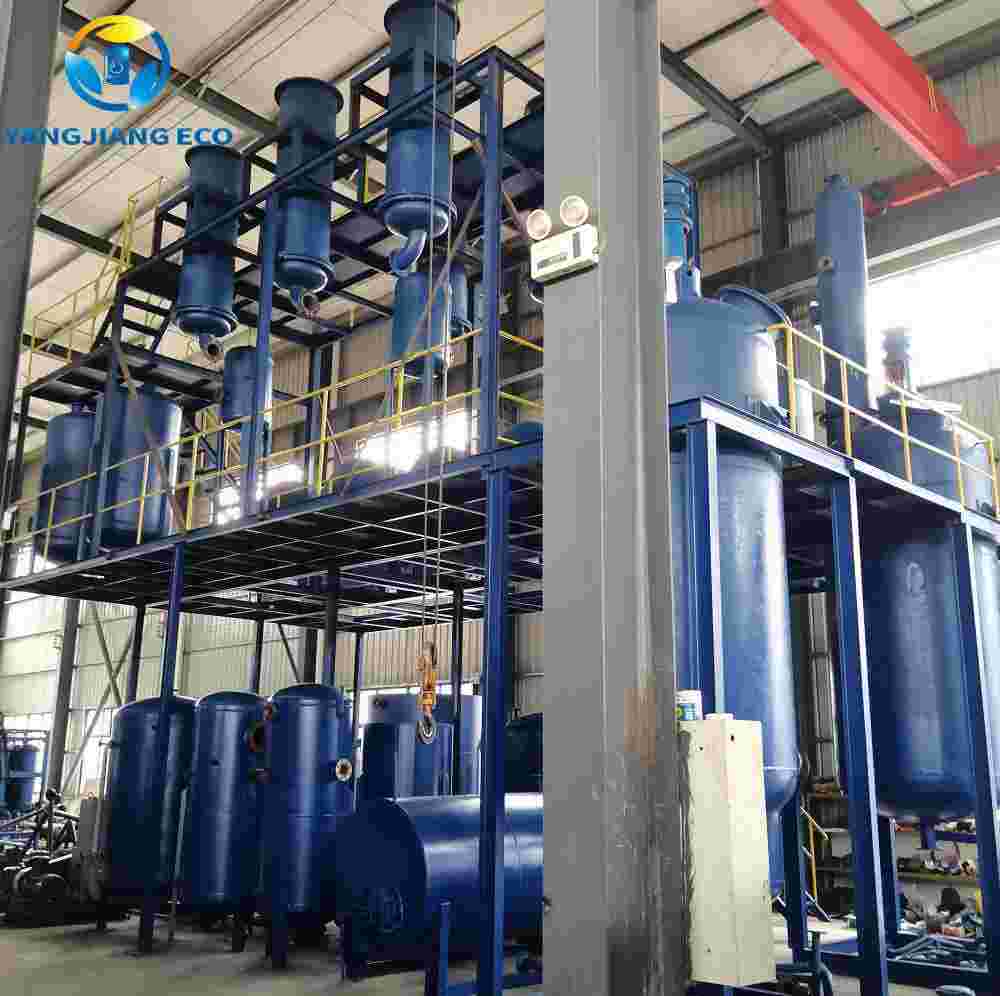
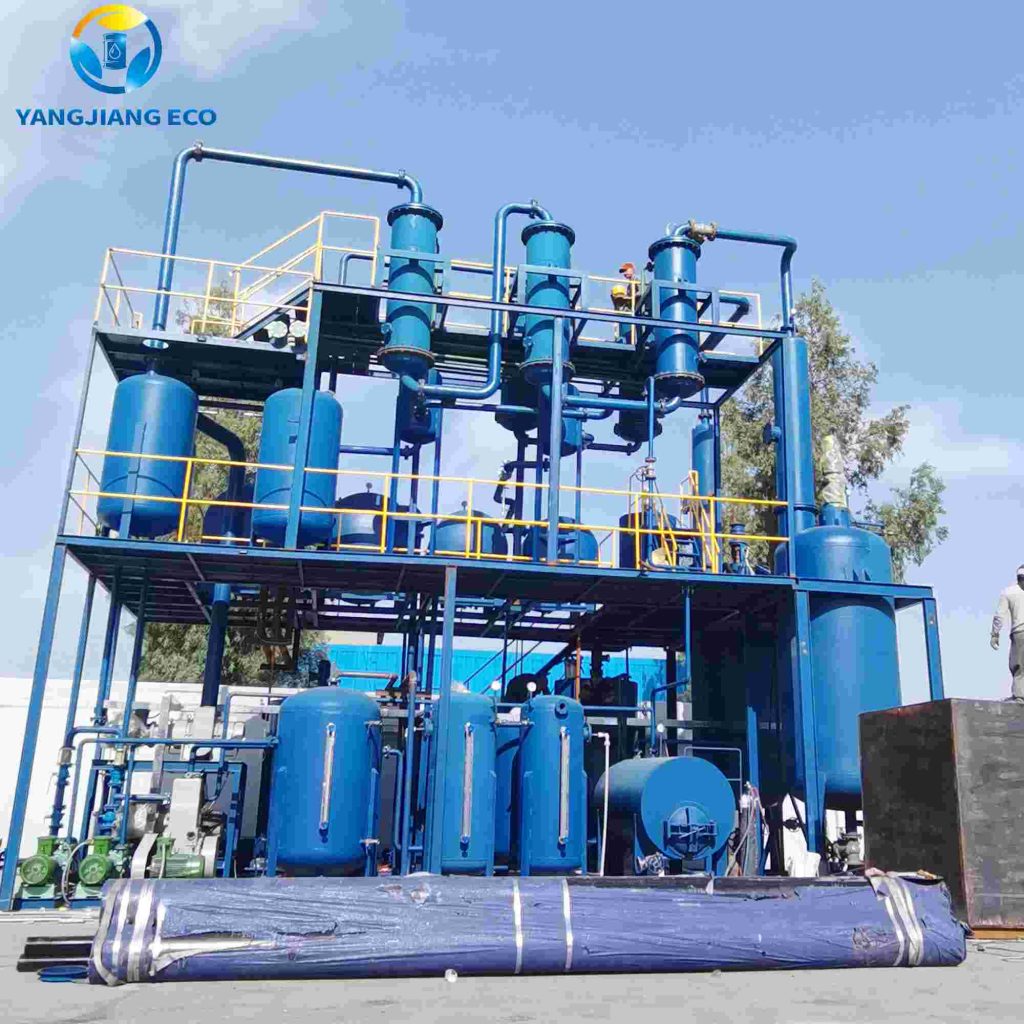
If your goal is to produce a higher-value refined product and build a long-term oil recycling business, a Waste Oil to Base Oil Recycling Plant can be a suitable choice. Our waste oil re-refining systems are designed to process used engine oil and waste lubricating oil into valuable base oil, with additional fuel fractions recovered during the refining process.
If your priority is lower investment and relatively simple fuel production, a Waste Oil to Diesel Distillation Plant may be more suitable. This system focuses on recovering usable diesel and fuel fractions from waste oil through an efficient distillation process.
Before investing, compare your feedstock cost, expected yield, product selling price, and operating expenses. The most profitable plant is the one that best matches your local waste oil supply and product market.