
Mechanical Automation Engineer
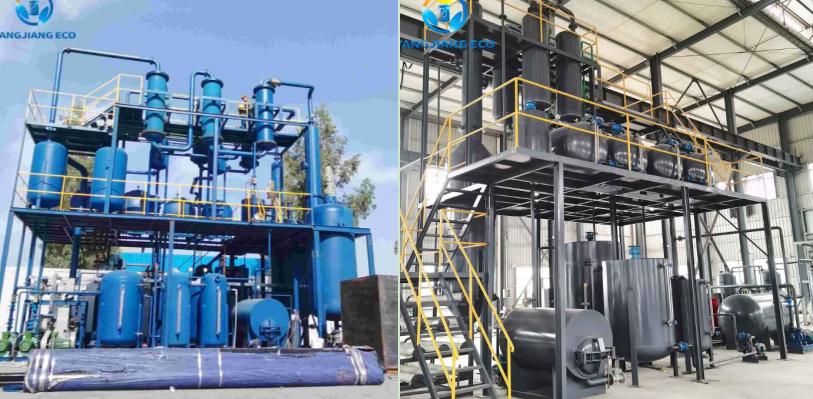
Selecting the appropriate capacity for a used oil recycling plant is one of the first and most important decisions you will make. This decision has a direct impact on your investment cost, stability, and speed in regaining your investment.
In practice, there are also some common pitfalls that many investors in used oil recycling plant projects have fallen into. They either select a plant that is too large in comparison to their supply or too small in comparison to their market. Both cases result in low profits.
This guide aims to present some practical factors to help you make an appropriate decision.
Why Capacity Selection Is Critical for Your Business?
Capacity measures how efficiently your plant is running on a day-to-day basis. As you have noticed, when your plant’s size does not match your real supply or demand, problems soon emerge.
- When your plant is oversized, it faces problems with inconsistent feedstock. As your plant is running at less than full capacity, your cost per ton goes up, and your capital is idle, earning no return.
- When your plant is undersized, your capacity to process your available waste oil is restricted, thus reducing your potential revenue.
In real-life situations, the problem is not in the technology; it is in matching the plant’s size with real-life conditions. Matching your plant’s capacity with real-life conditions enables your plant to operate smoothly, with a better chance to control your costs, thus reducing your payback period.
Common Capacity Options in the Market
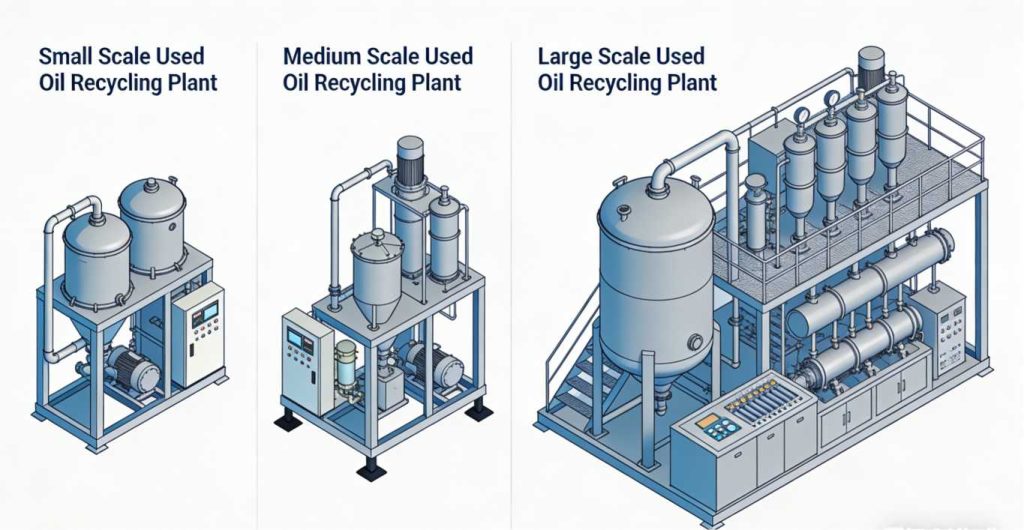
Small Scale (1–5 Tons/Day)
Small-scale units are normally adopted by investors who are venturing into the industry or are working in areas with limited waste oil availability. They are easier to put up and require less capital, making it easier to assess the viability of the project.
The disadvantage of a small-scale plant is that it requires a higher cost of processing per ton of oil. This means that the plant’s viability will depend on the consistent use of the plant. Small-scale units are normally put up to expand once the situation becomes clear.
Medium Scale (5-20 Tons/Day)
The most common choice is the medium scale because it is a trade-off between investment and efficiency. At this scale, the operation is more stable, and the cost per ton is greatly reduced.
This scale is appropriate for areas where there is a system for collecting waste oil and there is a steady market for recycled products. With this scale, the investor is able to maintain a steady operation without risking too much financially.
Large Scale (20+ Tons/Day)
This type of plant is geared towards industrial operations with existing supply chains in place. The cost of processing is reduced, making it a more efficient operation.
However, this type of investment is dependent on existing supply and demand support. Without a constant supply of waste oil, this type of plant would soon become idle. Additionally, the operational complexity and capital requirements are significantly higher, which makes this option suitable mainly for experienced operators or well-developed markets.
Key Factors to Determine the Right Capacity
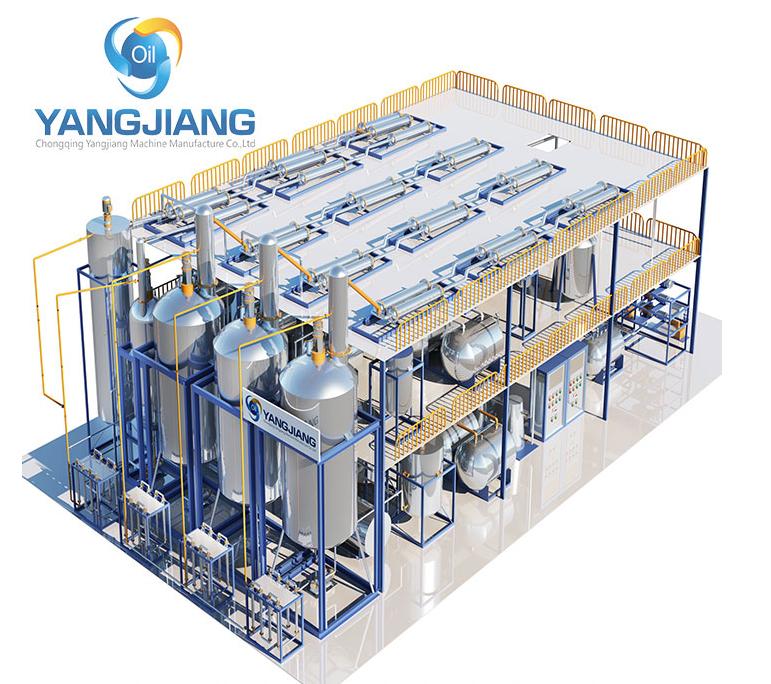
The question of capacity is not one of following a standard model; it is one of how your project will operate under real-world conditions. There are several aspects to take into consideration.
- The first is the waste oil supply. You have to have a good idea of how much feedstock is available to your project on a daily basis. While it is nice to have access to large quantities of oil from time to time, it is more important to have a consistent supply. A project that cannot operate consistently will have increasing costs and fluctuating outputs.
- An investment budget should also include more than just equipment. Besides the plant itself, there are installation costs, site preparation, utilities, and working capital. Capacity should also match within your financial range. Excessive capacity may put pressure on you before the project reaches steady production.
- Local market demand determines how easily you can sell your output. You should also consider who your buyers are and what they want to buy. You should also consider the price stability. Without a market, having high capacity only puts you at risk.
- Infrastructure and expansion planning also influence your decision. Land size, power supply, and future scalability should be evaluated early. In many cases, a moderate capacity with room for expansion is a more practical and controlled approach.
Capacity vs Profit: What You Should Know
It is a general assumption that more capacity results in more profit; however, in practice, it is seen that the reverse is true when conditions are not favorable.
Profitability is based on how efficiently the plant is running rather than the maximum output. A medium-sized plant running at almost maximum capacity can result in more profit than a large plant running intermittently. This is because fixed costs can be utilized more efficiently.
Another key point to remember is that the supply of the feedstock is often the constraint on production, not the capacity of the equipment. Investors who focus on scaling up production without securing supply often find their margins erode.
What is important in practice is not necessarily scaling up production, but running in a stable manner, controlling costs, and having access to markets.
How We Help You Choose the Right Capacity?
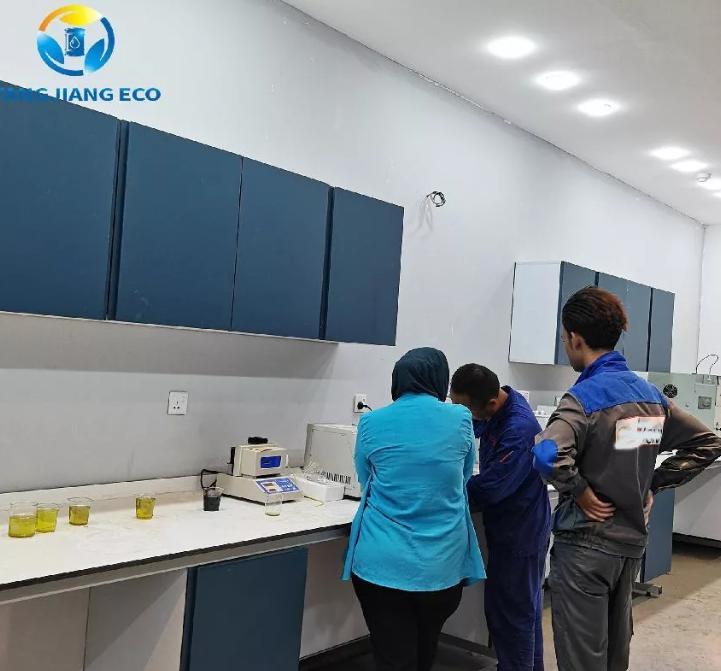
However, making a choice based on assumption is a gamble. In our case, in all the projects implemented by YANGJIANG, each recommendation is made on the basis of actual operation. First, we consider your waste oil supply, your local market, and your budget range, and then find the matching plant type.
Our plants are designed to be flexible. Regardless of your initial choice, whether small or medium capacity, we can always design to allow future expansions without reconstructing the plant.
Apart from that, we are available to assist with design, technical setup, as well as basic return analysis to help you understand how the plant will perform before you start.
If you are still not sure what size you need, you are welcome to share your project details with us. We will be able to make a practical recommendation.