

Mechanical Automation Engineer
For lubricant blenders and procurement managers, sourcing re-refined base oils is a strategic decision to optimize costs and supply chains, not a move driven solely by environmental considerations. However, the quality consistency of re-refined base oils remains a primary concern.
Thanks to modern used-oil re-refining technologies, the performance of re-refined base oils now rivals—or even surpasses—that of virgin base oils. To ensure engine safety and enhance market competitiveness, re-refined base oils must strictly comply with API and ASTM quality standards.
The Core Quality Parameters That Actually Matter
1. Saturate Content (ASTM D2007)
The content of saturated hydrocarbons is the key indicator for classifying API I and II base oils:
- Group I Target: Saturated hydrocarbon content is less than 90%
- Group II Target Saturated hydrocarbon content is not less than 90%
Low saturated hydrocarbon content corresponds to high aromatics, which is prone to causing engine thermal oxidation, sludge accumulation and thickening of the oil. Therefore, to achieve a saturated hydrocarbon content of 90% or above, deep chemical processing must be adopted instead of simple physical filtration or clay refining.
Sulfur Content (ASTM D4294 / D5453)
Used engine oil is naturally rich in sulfur, mainly derived from combustion residues and extreme pressure additives:
- Group I Standard: Greater than 0.03% (up to 300 ppm or higher)
- Group II Standard: Not greater than 0.03% (less than 300 ppm)
High sulfur content weakens additive performance and causes “poisoning” of emission catalysts. Untreated used oil with excessive sulfur content often exceeds 0.1% and cannot be used in modern engine oil formulations.
Viscosity Index (ASTM D2270)
The viscosity index (VI) measures the viscosity stability of oil products under extreme temperature changes:
Standard target: 95 to 120 (depending on the fraction specifications, such as SN150, SN300, SN500).
Core significance: A VI below 90 is usually caused by distillation failure or fuel contamination. By precisely cutting the fractions through vacuum distillation, the oil product can maintain a stable oil film strength under high heat load.
Flash Point and Volatility (ASTM D92 / Noack)
Flash point is the lowest temperature at which vapor can be ignited, and the Noack test is used to assess volatility loss:
- Flash point indicators: Light fractions (such as SN150) are above 200°C; heavy fractions (such as SN500) are above 220°C.
- Noack volatility: Volatility loss at 250°C is less than 15%.
A low flash point indicates contamination by light components (residual gasoline). If the pre-treatment fails to thoroughly remove these components, the finished oil not only poses a serious fire hazard but also leads to excessive oil consumption in the engine during operation.
Color and Odor (ASTM D1500)
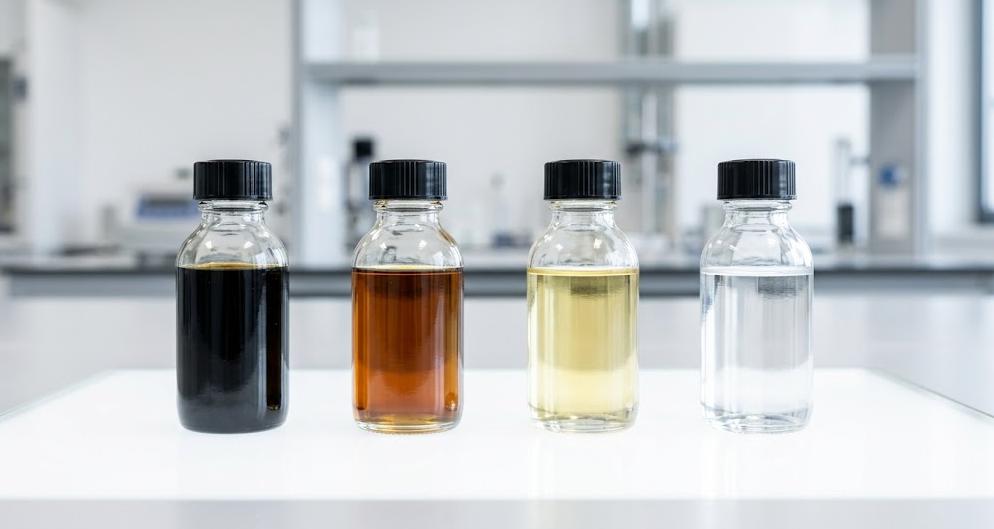
- Standard color: ASTM color 0.5 to 1.5 (from water white to light yellow)
- Odor indicators: Neutral, without pungent chemical odor or burnt or charred smell
Core meaning: Color is the most intuitive indicator of refining quality. Darker color or brownish tint indicates higher aromatic hydrocarbon content, overheating cracking or residual additives and oil sludge; while a neutral odor confirms that the volatile organic compounds and sulfides have been successfully removed from the oil.
How Quality Control Teams Audit Re-Refined Base Oil Shipments

The quality control team of the blending factory not only reviews the general specification documents, but also takes additional measures to verify batch consistency:
- Batch COA comparison: Compare the analysis certificates (COA) of each batch with the reference samples to ensure that the viscosity and density are highly consistent.
- ICP heavy metal and additive screening: Use ICP technology to screen for metal residues (iron, copper, lead) and additive residues (calcium, zinc, phosphorus). The total amount of metals must be below 5 ppm to prevent sediment formation and catalyst poisoning.
Group I vs. Group II Re-Refined Base Oil Specification
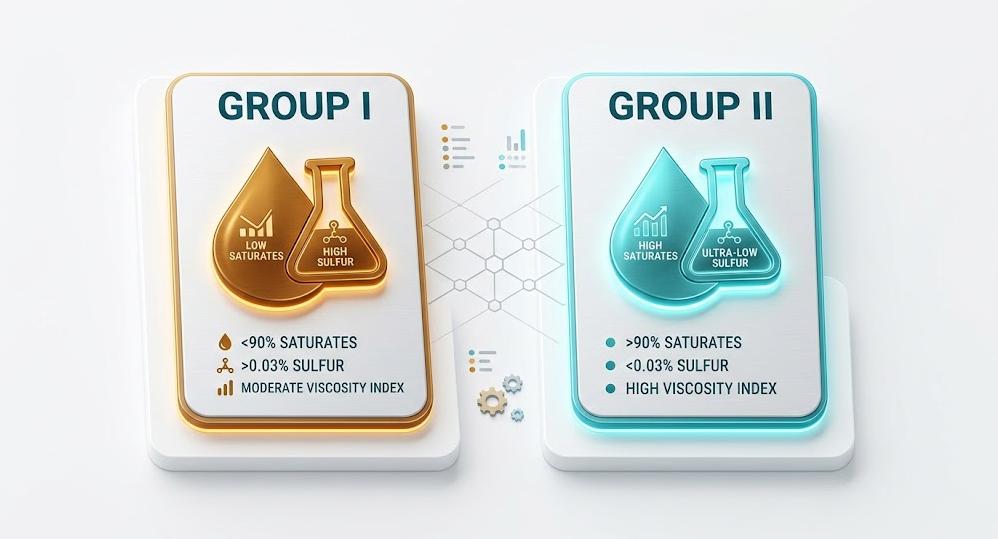
Although both serve the lubricant industry, the core differences between Group I and Group II recycled base oils lie in the content of saturated hydrocarbons, sulfur content, and oxidation stability. Group I base oils are suitable for general industrial oils and traditional engine oils; while Group II base oils have a higher market premium due to meeting the rigidity requirements of modern low-emission vehicle engines.
The following table provides a detailed comparison of the key technical indicators of these two types of base oils:
| Quality Parameter | Test Method | Typical Group I Base Oil | Typical Group II Base Oil |
| Saturates (%) | ASTM D2007 | Under 90% | 90% or higher |
| Sulfur Content (%) | ASTM D4294 | Over 0.03% | 0.03% or lower |
| Viscosity Index (VI) | ASTM D2270 | 95 – 105 | 105 – 120+ |
| Flash Point (°C) | ASTM D92 | Above 200°C | Above 215°C |
| Color | ASTM D1500 | 1.5 – 3.0 | 0.5 – 1.0 (Water-White) |
| Total Acid Number (TAN) | ASTM D664 | Under 0.05 mg KOH/g | Under 0.03 mg KOH/g |
How Processing Technology Directly Dictates Oil Quality
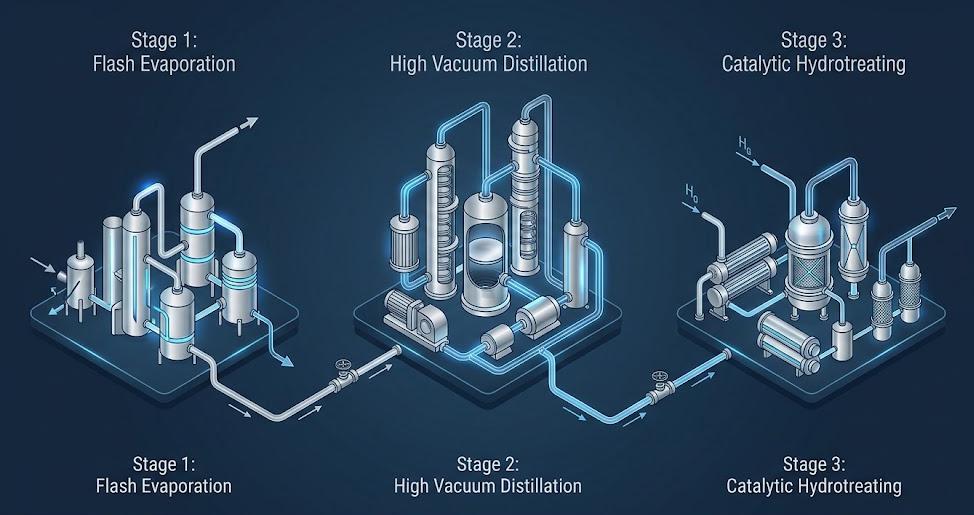
The aforementioned quality indicators cannot be achieved through basic filtration or acid treatment. The final specifications are entirely dependent on the engineering design of the factory:
The limitations of the “acid-soil” method: The “acid-soil” process can only remove large impurities and odors, but cannot remove sulfur elements, raise saturated hydrocarbons to the API II standard, effectively remove dissolved heavy metals, and also generates a large amount of toxic sludge.
Modern three-stage continuous process:
- Pre-treatment and flash evaporation: Remove moisture and light fuels to ensure high flash point.
- High vacuum distillation: Separate heavy asphalt, precisely cut different viscosity grade fractions (SN150, SN300, SN500).
Catalytic hydrogenation/solvent refining: Through hydrogenation, convert aromatics into saturated hydrocarbons, remove sulfur and improve color, and stabilize to meet the strict API II standards.
Frequently Asked Questions
- Question: Can recycled base oil completely replace the original base oil in engine lubricants?
Answer: Yes. The API considers recycled base oil meeting the I/II standards to be equivalent to the original base oil. Lubricant mixers can directly replace the original oil without having to redesign the additive formula.
- Question: What are the main reasons for the non-compliance of the color or the presence of odors in recycled base oil?
Answer: The root cause lies in insufficient hydrogenation treatment or excessive thermal cracking during vacuum distillation. If the temperature is out of control, heavy hydrocarbons will decompose into volatile organic compounds, causing the oil to change color and produce an odor.
- Question: What is the maximum allowable content of metal contaminants in commercial-grade recycled base oil?
Answer: The individual content of heavy metals and wear metals (lead, copper, zinc, iron, calcium) should be below 1–5 ppm, and the total content should be below 10 ppm. High metal concentrations will exacerbate engine wear and cause poisoning of the exhaust catalyst.
- Question: How does catalytic hydrogenation treatment increase the content of saturated hydrocarbons and the viscosity index?
Answer: Under controlled temperature and pressure, hydrogenation causes unsaturated aromatics to react with hydrogen, converting active aromatic rings into stable saturated hydrocarbons (alkanes and cycloalkanes), thereby increasing the saturated hydrocarbons to over 90% and improving the viscosity index.
Conclusion
Meeting API Group II parameters consistently requires precision-engineered distillation and hydrotreating systems.
At YANGJIANG, we design and manufacture complete waste engine oil recycling plants tailored to your target product specs. Contact our engineering team today to review process designs, yields, and customized plant layouts for your investment project.