When building a facility for blending oils, it is easy for investors and factory managers to pay significant attention to such components as tanks and mixers, but sometimes the central part of their business is forgotten – formulations of additives and management systems. The transition from experimental formulation to production involves more than just mixing substances. It is important to know how additives react with oil base and how it is possible to conduct such a process without any failures.
Why Laboratory Formulations Fail in Full-Scale Lube Blending
The scaling up of a working laboratory-formulated lubricant to high-volume production is among the biggest obstacles facing lubricants manufacturers and waste oil re-refiners. In the laboratory setting, mixing the base oil with an additive package in a beaker is a simple process. But once you scale it to thousands of liters per batch, real-world physics and mechanics such as fluid dynamics, thermal gradients, shearing, and dosing accuracy become factors.
In many cases, operators realize that despite following the API or ACEA specification to the letter, their end product doesn’t meet the required standards. The viscosity index changes, high-cost additives precipitate in storage, or the batch consistency becomes worse. To start a lucrative blending business, operators need to connect the dots between chemistry and engineering. While understanding the fundamental lube oil blending process provides a solid chemical foundation, solving the most common industrial blending problems requires knowing how good equipment design protects product quality at scale.
Controlling Additive Dosing Accuracy to Prevent Cost Overruns
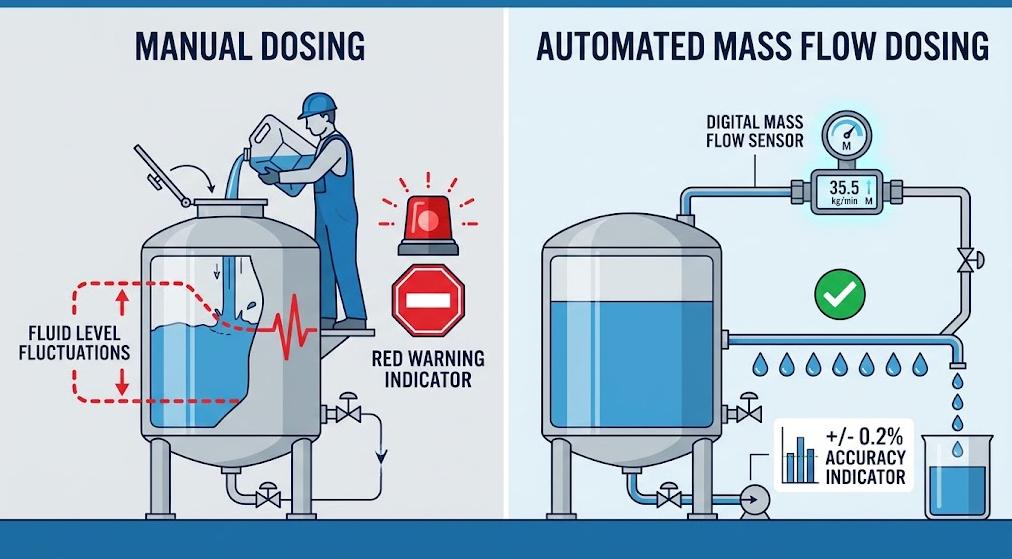
High Performance Lubricants contain performance additives including detergents, dispersants, anti-wear, and rust inhibitors that may constitute as little as 5-20% of the entire blend weight. Specialty Single-Additives, such as anti-foaming agents and Pour Point Depressants (PPD), may be present in trace amounts of 0.1-0.5%.
When it comes to conventional or low-cost oil blending operations, manual addition of additives via bucket dosing or metering is commonplace. Such a method poses two major threats:
- Under-Dosing: A discrepancy between the required and actual additive level of 0.1-0.5% can result in oil not meeting anti-wear (ZDDP) or oxidation stability requirements.
- Over-Dosing: The practice of adding excessive amounts of additives “just in case” increases the cost of raw materials substantially. Performance additive packages constitute some of the most expensive ingredients when producing lubricants; over-dosing negatively impacts margins right away.
In order to reduce the risk of mistakes made during the dosing process due to the difference in the density of the fluid depending on its temperature, automated dosing is used in contemporary plants. YANGJIANG uses an automated dosing system with highly accurate mass flow meters and pulse dosing control in the YJ-BYL Lube Oil Blending Plant. As a result, the dosing accuracy equals +/– 0.2%.
Temperature and Shear Control for Polymer Dissolution
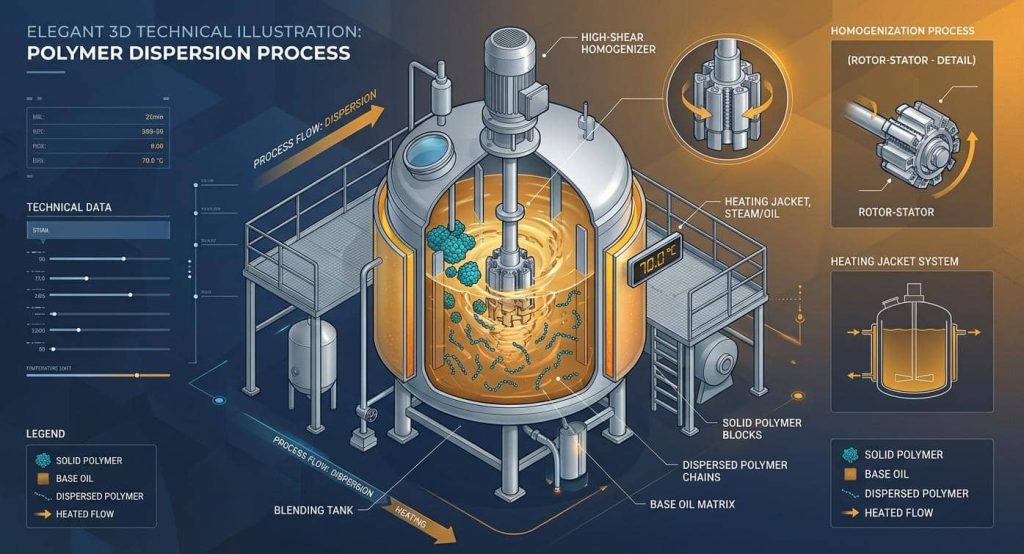
Multi-grade engine oil blending (i.e., 5W-30 or 15W-40) necessitates the use of Viscosity Index Improver (VII), which is normally made from solid or viscous polymer blocks (Olefin Copolymers / OCP). Full dissolution of the polymer in the blend formulation represents an energy-intensive operation with respect to the entire process of blending.
The procedure poses two main technical challenges:
- Dissolution Incomplete & Phase Separation: Insufficient or uneven thermal energy applied below 60°C means that there would be no full dissolution of the polymer, and subsequent phase separation would occur. When packed in a bottle or container and stored in a low-temperature environment, undissolved polymers separate to form a gel phase.
- Polymer Shear Degradation: Using too much heat (greater than 100°C) or exposing the mixture to overly aggressive mechanical shearing will permanently destroy the long-chain polymer chains. Even if the initial viscosity seems right, the final oil will quickly fail the Shear Stability Index (SSI) test within the running engine and leave engine parts unprotected.
The proper balance can be achieved through accurate temperature control coupled with agitation. The YANGJIANG YJ-BYL system uses a thermal oil jacket heating system along with a high-shear homogenizer. The thermal oil jacket ensures gentle heating (60°C – 80°C) of the polymers without thermal oxidation, while the high-shear agitator ensures the breakdown of the polymer blocks to the molecular level without shearing of the molecular chain.
Preventing Cross-Contamination in Multi-Grade Production
The capacity for adaptation is vital in small- to medium-sized blending plants for the preparation of lubricating oils. The operator has to constantly change the production line from one product line to another; that is, to prepare the HDDEO in the morning and prepare the zinc-free hydraulic oil or transformer oil in the afternoon, for example.
There is always the danger of cross-contamination during changeovers from one blend to another. Engine oil with additive compounds such as calcium, magnesium, or zinc can contaminate the industrial hydraulic oil and compromise its ability to demulsify the water. The same contamination in the transformer oil will lower its dielectric breakdown voltage.
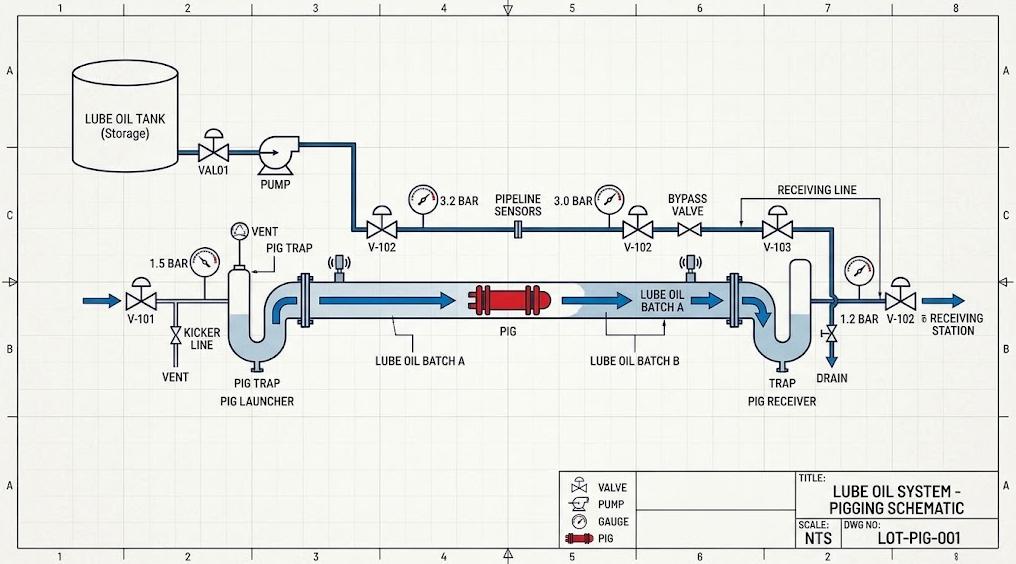
Cross-contamination is prevented through special design that avoids the dead zones and facilitates fast flushing:
- Pipe Design: Manifold design ensures that incompatible fluids will not pass within the same pipe.
- Tank Design: Conical tanks avoid any dead zone that would allow remaining fluid in the vessel after it has drained out by force of gravity.
- CIP & Pigging: Automatic pipeline cleaning systems help minimize solvent usage and eliminate downtime when changing over batches.
The YJ-BYL Lube Oil Blending Plant is equipped with a modular pipeline design and PLC-controlled system of flushing. The operator can enter dozens of recipes that comply with the API standard into the system and change the type of lube oil without any risk of cross-contamination.
Complete Lube Oil Blending Solutions by YANGJIANG
Setting up a lucrative lubricant blending business involves much more than just purchasing blending tanks; rather, it requires a perfect blend of the right chemistry, additives, and process engineering. Whether you want to expand your re-refined base oil blending capacity or start your own lubricant brand, your equipment should assure you of perfect batch-to-batch consistency.
Here at Chongqing YANGJIANG Machine Manufacture Co., Ltd., we offer turnkey engineering solutions that cater to your production capacity.
Besides manufacturing the most advanced Lube Oil Blending Machines, our engineering team will also offer you plant layout design, process design, additive dosing system integration, and installation support. Learn how our systems can improve your production process and margin with the advanced YJ-BYL Lube Oil Blending Machine.