An effective feedstock pre-treatment system ensures that waste oil is properly prepared for distillation. This design must be based on various factors, including the moisture content, solid impurities, viscosity, and other contaminants in the oil. The purpose is to determine appropriate equipment for separation and dehydration.
Analyze the Waste Oil Before Selecting Equipment
Prior to the development of the pre-treatment system, take samples of the waste oil and carry out their analysis. Various types of feedstock may need different treatment processes, and thus the selection of equipment cannot be made based on its appearance.
The following parameters need to be checked:
- Water content: Determines the required dehydration capacity and whether additional water separation is needed.
- Solid impurities: Indicate whether settling, coarse filtration, or mechanical separation is needed.
- Viscosity: Impacts pumping, heating, and filtration processes.
- Light contaminants: Gasoline, diesel, and other volatile substances may require additional treatment and specific safety measures.
The results of testing will serve as the basis for selecting equipment and the sequence of the treatment process.
More details can be found in How to Test Waste Engine Oil Before Buying It for Recycling.
Select the Main Equipment for Feedstock Pre-Treatment

The pre-treatment process will generally consist of different pieces of equipment. Their choice is dependent on the quality of the feedstock and processing capacity needed.
Settling Tanks and Solid Separation
Settling tanks provide an opportunity to separate heavier particles and free water from the waste oil using gravity. Then, the separated water and sludge can be discharged through special outlets.
When dealing with feedstock that has many suspended solids, it may be useful to use a centrifuge to enhance solid/liquid separation. It is dependent on the particle properties, oil viscosity, and capacity needed.
The tank should provide sufficient settling time and convenient access for sludge removal and cleaning.
Filtration Equipment
Filters separate solid contaminants that are present after initial separation and settling.
There should be a coarse filter that would collect large particles and serve as protection for the downstream equipment. Then, further filtration will remove the smaller suspended solid contaminants before oil goes into the distillation unit.
The required filtration rating depends on the feedstock condition and the requirements of the downstream process. An inappropriate filter might lead to increased expenses or blockages.
Filter replacement and cleaning should also be considered during system design.
Heating and Dehydration Equipment
“Heating can reduce waste oil viscosity and improve water separation. The required operating temperature depends on the feedstock characteristics and the selected dehydration method.”
For feedstock containing large amounts of free water, settling can be used as the initial separation stage. For the dehydration to become effective, vacuum or other methods can be used for evaporation.
A dehydration unit must incorporate the proper means of steam condensation and water removal. An excess quantity of water during the distillation of oil negatively influences the process and increases the energy consumption.
Arrange the Pre-Treatment Process Flow
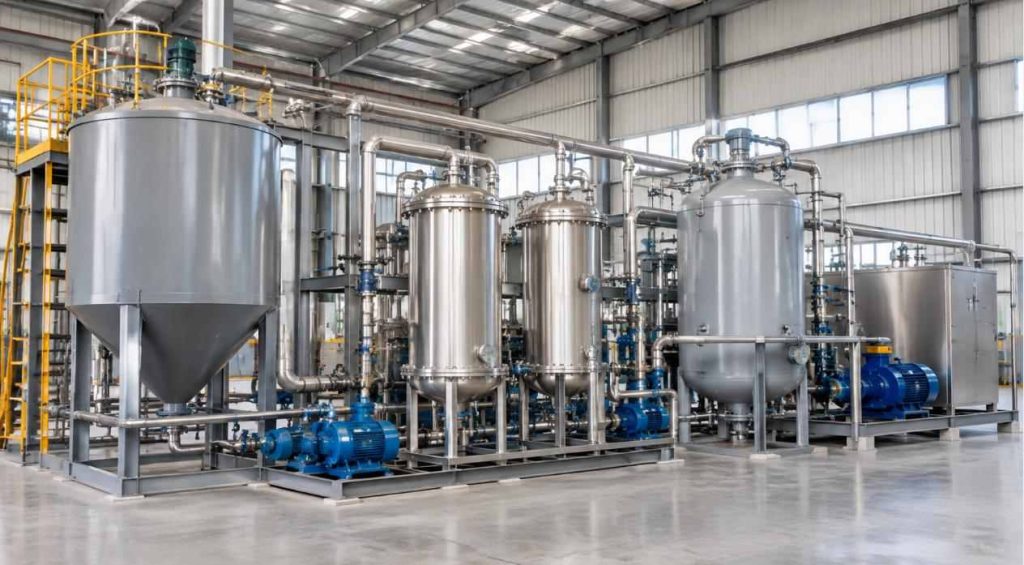
After choosing the equipment, lay out the units in an order that will facilitate efficient separation and feedstock delivery.
For instance, a process arrangement for a conventional pre-treatment of waste oil may look like this:
- Feedstock receiving tank – receives the feedstock and allows preliminary inspection and temporary storage.
- Settling and coarse separation – removal of free water and heavy solid impurities.
- Coarse filtration – removal of large particles before further processing.
- Heating and dehydration – lowering of viscosity and water removal.
- Fine filtration – removal of suspended particles.
- Feed buffer tank – storing of processed feedstock and delivery to the distillation unit in a more stable manner.
This is a generalized process arrangement and not a rigid one for each particular plant. Feedstock with high water content, high amounts of solid impurities, or emulsification may need additional separation steps.
The system shall also have appropriate pipelines, outlets for discharge, sampling points, and isolation valves.
Match the Pre-Treatment System with Distillation Capacity
The pre-treatment facility needs to produce an adequate amount of treated oil, sufficient for actual distillation plant feed requirements.
Its capacity will depend on how much oil the plant is supposed to treat daily and on its operating hours. Other factors should also be taken into account when designing the pre-treatment facility, such as the variability of raw materials supply and feedstock quality.
Storage and buffer tanks help balance fluctuations in waste oil supply and the feed requirements of the distillation process. Pumps and pipelines should be selected according to the oil’s viscosity and required flow rate.
Different schemes are possible depending on whether the distillation plant is continuous or batch type.
For a complete equipment solution, see Waste Oil Distillation Machine and Used Oil Treatment System.
What Should Be Considered Before Finalizing the Design?
Some factors have to be incorporated into the final engineering design:
- Feedstock compatibility: Different types of waste oil should be evaluated before mixing to avoid introducing incompatible or hazardous contaminants.
- Safety measures: Proper ventilation, temperature control, and fire protection should be considered when designing storage tanks, heating equipment, and pipelines.
- Handling of waste: Sludge, filter wastes, and collected water should have dedicated disposal means.
- Accessibility: There must be enough room for filter replacement, tank cleaning, and checking of the equipment.
- Monitoring: Sampling facilities and thermometers need to be provided in necessary places.
All these considerations make the system more reliable.
Summary
Designing a waste oil pre-treatment system requires matching the treatment process with feedstock characteristics and distillation capacity. By selecting suitable settling, filtration, and dehydration equipment, a plant can prepare more consistent feedstock for downstream processing. YANGJIANG provides waste engine oil to base oil recycling machines and integrated equipment solutions for different waste oil treatment projects.