
Mechanical Automation Engineer
If you are still paying for the services of waste management firms to get rid of your used lubricants or using old-fashioned and inefficient filtering systems, you are wasting tons of money. In the current industrial environment, complying with environmental standards is not just about evading substantial fines but also means surviving in the industry. Industrial Used Oil recycling has become one of the most profitable niches in modern resource recovery.
However, there is one thing that should be kept in mind: without proper equipment that produces poor-quality oil, which nobody wants to purchase, no profits will be achieved.
As a company with 20+ years of development and manufacturing experience, YANGJIANG has seen the changes that occurred in the international market. We are not just producing machinery – we produce ready-to-use oil refining complexes that transform dark, hazardous waste into valuable products.
Categories of Industrial Used Oil Recycling
Among the most costly blunders that the managers of the factories have been known to make is placing all kinds of waste liquids together in the same storage tank. All used oils are not alike. Mixing together hydraulic oils, gear oils, turbine oils, and soluble cutting fluids makes the chemistry of the treatment process an absolute nightmare. The efficiency of the distillation process will be severely compromised when you place badly degraded transformer oil in combination with engine oil.
To get the most out of your investments, you need to know:
- Black Engine Oils: Containing carbon soot, heavy metals, oxidized additives, and fuel contamination. These oils need extreme thermal cracking to help disintegrate the complicated carbon chains.
- Industrial Gear and Hydraulic Oils: Have high viscosity, very little soot, but are known to suffer from extensive additive degradation, loss of anti-wear additives, and water emulsion problems.
- Transformer Oils: Specialized and low viscosity oils that need precise dehydration and degassing, and dielectric strength restoration to ensure grid safety.
It is precisely for this reason that a one-size-fits-all filter does not work. At YANGJIANG, we manufacture machinery according to your specific needs to get the best out of each type.
- For instance, if you require oil regeneration for high-voltage power grids, you will require our specialized Transformer Oil Regeneration Machine.
- Similarly, if you have automotive or ship dock fluids available in large quantities, you need heavy-duty distillation equipment.
Matching the machine to the specific molecular makeup of your feedstock is step number one to running a profitable recycling plant.
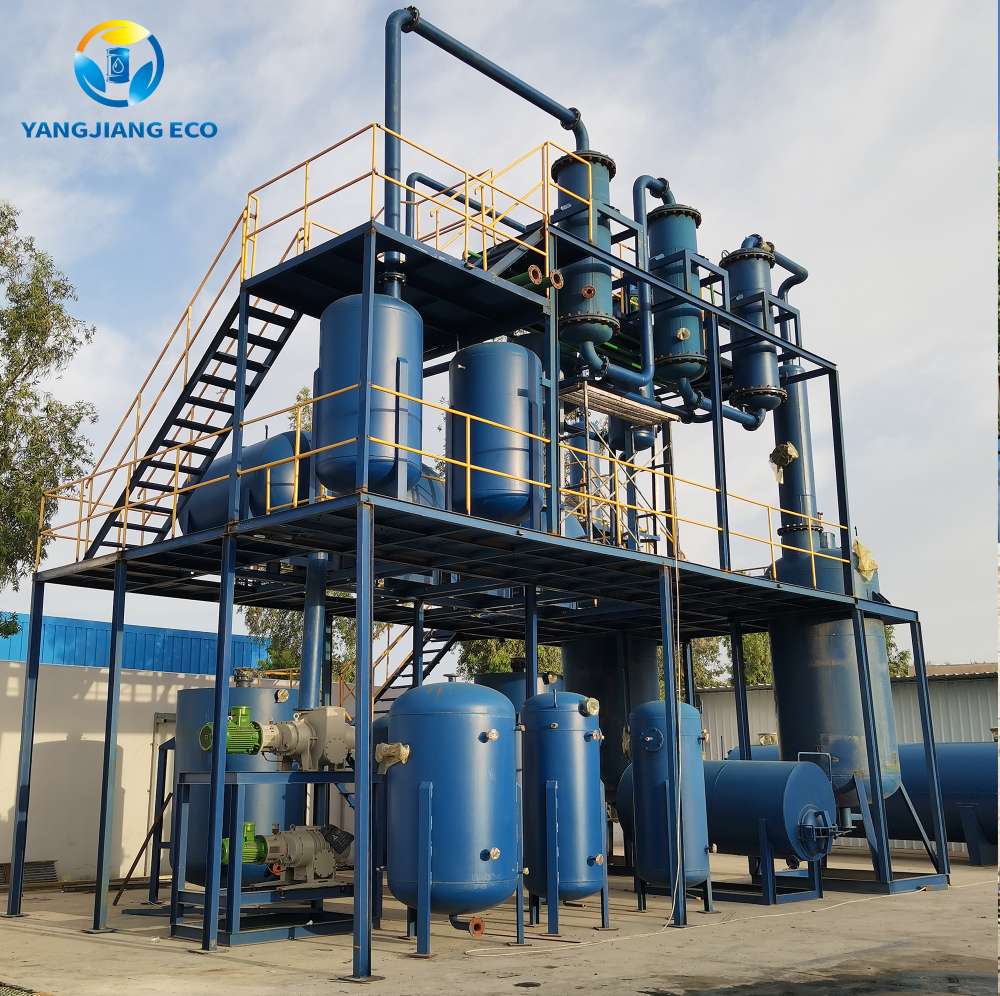
Refining Technology: Filtration vs. Vacuum Distillation & Solvent Extraction
When increasing an industrial oil recycling plant’s scale, choosing the proper separation and purification process is the key to successful product quality and profitability. The industry is dominated by two major solutions: mechanical filtration and thermal/chemical refining.
The Limitations of Physical Filtration
Mechanical filtering systems (such as centrifuges, depth filters, and activated clay filters) are purely mechanical in action. They are designed to eliminate suspended solids, metallic particles, carbon soot, and free water.
Though highly effective as a pre-filtration method or for maintaining hydraulic fluid in-line, filtration will not change the chemical composition of the old oil:
- No Light-Ends Elimination: There is no way to eliminate fuel, gasoline fractions, or other solvents through filtration, since their existence is responsible for keeping the oil’s flashpoint extremely low.
- Odor: Volatile organic compounds (VOCs), as well as sulfur fractions that cause the smell of waste oil, go uneliminated.
- Oxidation (Color Reversion): Even though after filtration the oil looks clear initially, the presence of unstable nitrogen, sulfur, and unsaturated hydrocarbons leads to quick oxidation when the oil is exposed to air and sunlight, and the oil turns pitch-black once again.
The Dynamics of Vacuum Distillation & Solvent Extraction
To produce market-ready lubricants that meet international standards (such as API Group II), the waste oil must undergo thermal cleavage and chemical refining.
- Vacuum Distillation: Instead of boiling the oil at extreme atmospheric temperatures—which destroys the hydrocarbon chains and creates excessive burnt sludge—the process is conducted under a deep vacuum<100 Pa. Lowering the pressure drops the boiling points of the hydrocarbons. This allows engineers to fractionate the oil precisely, vaporizing clean base oil and diesel while leaving heavy metals, asphalt, and polymers behind in the bottom residue.
- Solvent Extraction: The distilled oil fractions still contain trace polar compounds and sulfur aromatics. Rather than utilizing hazardous traditional acid-clay treatments, modern refining uses a closed-loop solvent extraction process. A specific, recyclable solvent binds to the impurities and separates them by density. The solvent is then stripped, recovered, and recycled back into the system.
| Technical Parameter | Physical Filtration Systems | Vacuum Distillation + Solvent Extraction |
| Primary Separation Mechanism | Mechanical particle trapping | Fractional vaporization & liquid-liquid extraction |
| Contaminant Removal Capabilities | Solids, soot, and free water only | Fuel dilution, VOCs, sulfur, heavy metals, and polymers |
| Output Quality Standard | Cleaned waste oil (Industrial fuel grade) | High-purity, stable API Group II Base Oil |
| Flashpoint Correction | No effect | Fully restored by stripping light-end fractions |
| Color and Odor Stability | Poor (Reverts to black under UV exposure) | High (Permanently stable, water-white to pale yellow) |
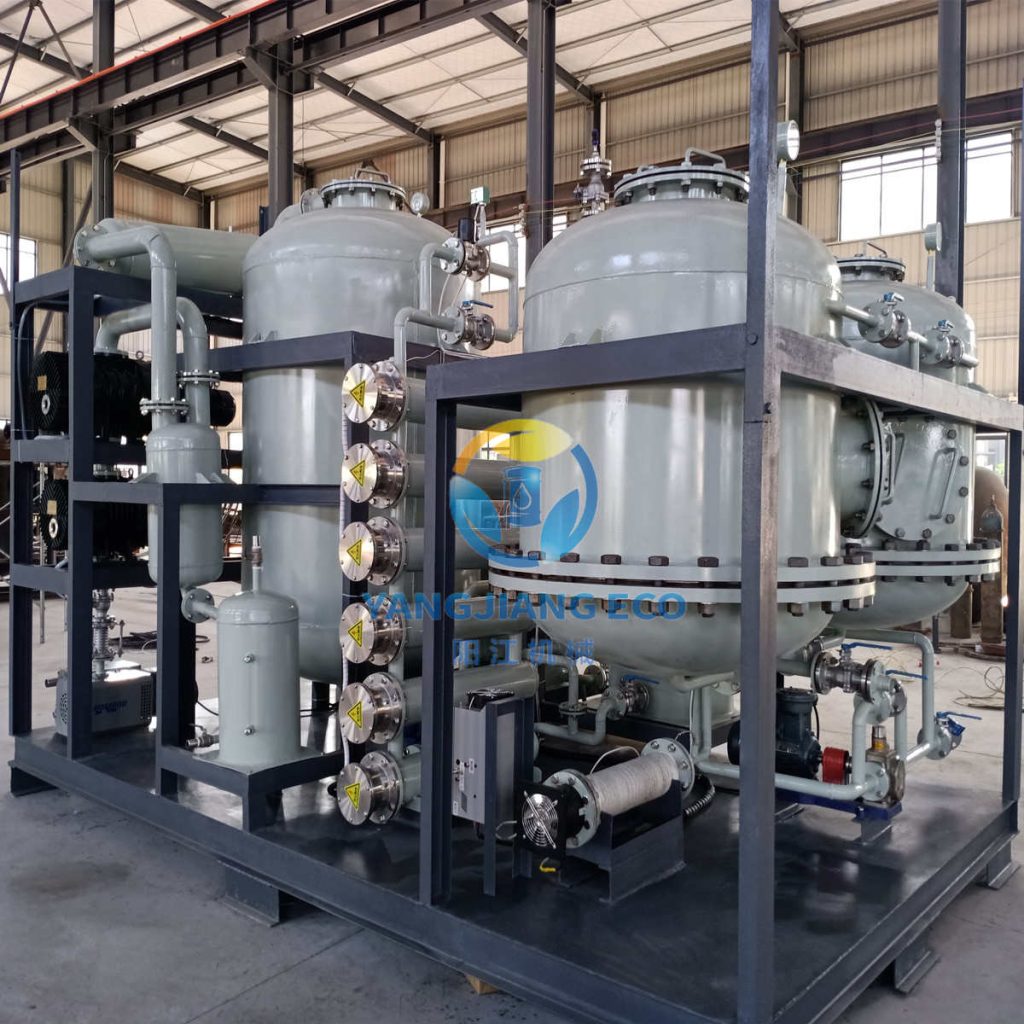
Implementing this advanced dual-stage approach requires high-precision thermal control and robust vacuum sealing. As an established manufacturer in this sector, YANGJIANG integrates these exact principles into our heavy-duty industrial systems, including the YJ-TY Vacuum Distillation Plant and YJ-SR Solvent Extraction Machine, ensuring facilities achieve high yield efficiencies and strict eco-compliance on a commercial scale.
The Real ROI of an Industrial Oil Recycling Plant
In no way do we advise our clients to procure any equipment on mere promises. Allow us to demonstrate the true mass balance and economic sense behind establishing a mid-sized to large-scale refining plant. In case you are refining average auto or industrial lubes through a YANGJIANG configuration, your average yield will be as follows:
- High Quality Base Oil / Diesel Fraction: 75%-85%. The main source of your earnings will be either sold as a blending base or industrial fuel.
- Light Fuel / Gasoline Fractions: 3%-5%. These fractions are used in the plant’s own burner units and will reduce fuel expenses drastically.
- Water Content: 5%-8%. Water fraction is separated in the very beginning and will be vaporized in the water purification unit.
- Asphalt Residue / Sludge: 6%-8%. Heavy fraction that is used in asphalt blending plants or waterproofing production – 0% waste.
This is because the plants we use have excellent heat insulation and burn back the light ends from our plants as the fuel. Your energy bills will be at the absolute lowest per ton for this reason. In addition to this, YANGJIANG is the expert when it comes to modular plant design. This is because we pre-assemble skid-mounted and modular plant blocks in our workshops, which means that your installation time, pipe fitting time, and commissioning time are reduced by more than 40%.
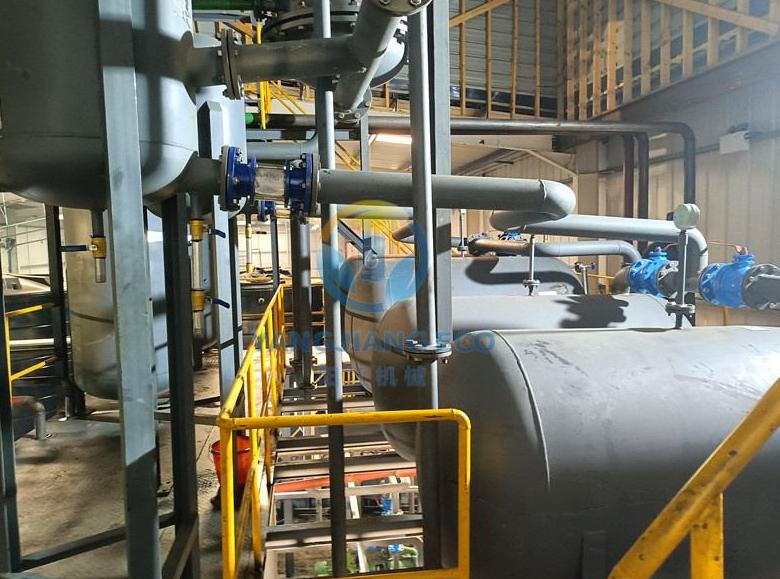
Get a Professional Layout & ROI Calculation for Your Project
No two waste oil projects are identical. Plant configurations vary based on feedstock water content, local utility costs, and regional emission standards.
Stop guessing about capacities, yields, and compliance. Contact YANGJIANG today for a professional plant layout, custom equipment configuration, and an accurate ROI calculation tailored to your market.
Click “Get A Quote” or connect via WhatsApp with your daily processing volume and primary feedstock types to get started.